
The Smithsonian recently reported that Merriam-Webster’s 2023 Word of the Year is “Authentic.” As AI keeps blurring or manipulating what’s real, our craving for truth deepens—especially in leadership.
We say we want authenticity.
We want people who are real, histories that are true, and organizations that honor both.
But… do we really?
A few years ago, I published research on the truth and authenticity of a story that shaped one very famous organization:
The United States of America.
Every July, Americans celebrate that glorious day when the Founding Fathers—visionaries of liberty and rebellion—gathered in a grand hall, signed a sacred document, and declared independence from England, and birthed a nation.
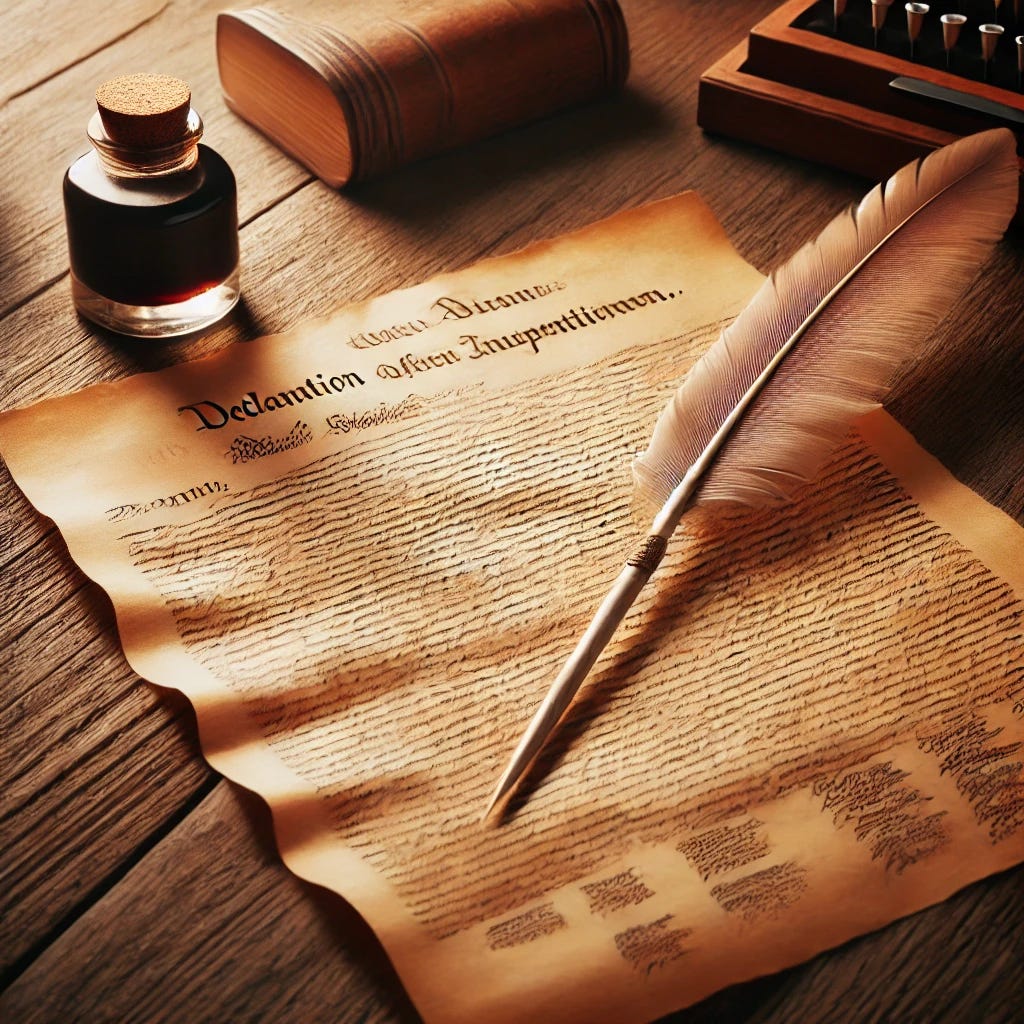
At least, that’s how the story goes.
It’s in our paintings, textbooks, films, and the fireworks soundtrack of our national imagination.
But something about it always bugged me.
If these leaders were committing treason against the most powerful empire on earth,
Why would revolutionary leaders all gather in one place—like ducks in a barrel—for the King’s spies to report and British troops to capture?
With British spies everywhere (Americans were still British citizens) wouldn’t THIS be the opportunity to squelch the rebellion? Surround the building and arrest all the leaders; game over. King’s happy, and we go back to that nasty taxation without representation thing.
Autopsy
(debunking history)
Turns out, the King couldn’t arrest the Founding Fathers - because most of them weren’t even there!
Not all. Not even close.
Well, there were two.
. . . maybe we should back up a second.
The real story is far messier—and much more human. Instead of a single, cinematic signing, the Declaration of Independence was a staggered, bureaucratic process filled with hesitation, political infighting, and administrative delays that stretched over years.
Yes—years.
What really happened?
Let’s rewind to June 1776.
Virginia delegate Richard Henry Lee proposed independence to the Continental Congress.
You’d think the vote was immediate—cue the fireworks, right?
Nope.
The colonies were divided:
-
Seven voted to postpone (“Let’s table this before anyone loses their head.”)
-
Five flat-out opposed independence (“Bad idea. Stupid risk.”)
-
New York, the power broker of the bunch, abstained entirely (“We’re busy inventing skyscrapers. Anyone seen an elevator yet?”)
So much for unity.
What? We all didn't want independence? That's inauthentic. How did THIS get covered up?
A month later, the debates resumed. Tempers flared.
Finally, twelve of thirteen colonies—New York still holding out—approved independence.
Therefore, contrary to popular belief:
The vote for independence happened on July 2!
WTF? So, July 4 is inauthentic too?
The Forgotten Holiday
John Adams, never one to stay quiet, wrote to his wife Abigail the next day, July 3rd, about what happened the day before.
“The Second Day of July 1776, will be the most memorable Epocha, in the History of America.”

Two days later, Congress finalized and dated the Declaration on July 4.
That’s all it was—the date on the document, not the date of the vote!
The truth?
July 4 was never the day we declared independence.
Whaaaat!!!
Myth Busted
Apparently, when we wrote the history books, somebody forgot to check John Adams letters to his wife (eventually somebody did, see the publication "The Letters of John and Abigail Adams", edited by Frank Shuffelton).
OK, so how did we miss this?
Historian Richard Shenkman (Legends, Lies & Cherished Myths of American History) uncovered how the confusion stuck.
Let me rephrase,
"Never let authenticity get in the way of a good story!"
Shenkman discovered that a scholar in the nineteenth century found the John Adams' letter, and noticed the discrepancy.
Finally! So that scholar corrected the error so that our history would be authentic? He revealed that we had the wrong date so that the story could finally be true?
No.
He quietly “corrected” the record—changing the date to July 5 so the myth would fit. That way Adams’ prediction for the holiday would be the 4th of July, not the 2nd of July as originally written.
Then we all celebrated July 4!
Wrong again.
-
Even Congress didn’t celebrate until July 8.
-
Washington’s troops in New York heard about it July 9.
-
Savannah? August 10.
-
London? Two weeks later.
-
France? August 30.
Apparently, revolutions move at the speed of horse.
WTF!!!!
**** I know. Breathe. Go take a walk. Pour a bourbon . . . because it gets worse.
The Signing That Wasn’t
What about that iconic image of everyone signing together in Philadelphia’s grand hall?
Um, no. [sounds of head slapping]
Only two men signed the Declaration on July 4.
OK, Don. You made all this up! This is so unbelievable. Where’s your documentation? Where’s your proof?
Ok. You got me. I got all this in an obscure repository:
The U.S National Archives!
Go ahead. Check it out yourself.
The true, authentic story is that only two people signed the Declaration on July 4th: John Hancock, the president of the Second Continental Congress, and Charles Thomson, its secretary.
I assume it was probably done in a small room with no fanfare.
The rest trickled in over weeks, months—even years.
[sounds of heads hitting desks]
“It wasn’t until 1884 that the record was corrected when historian Mellon Chamberlain, researching the manuscript minutes of the journal of Congress, discovered that the declaration was signed by most delegates on August 2. A few didn’t affix their signatures until even later. One person didn’t sign until 1781.“
A few delegates who voted for adoption of the Declaration never signed it! Nonsigners included John Dickinson, who clung to the idea of reconciliation with Britain, and Robert R. Livingston, one of the Committee of Five, who thought the Declaration was premature.
Ok. Then it was over!
Well, not quite.
When 56 delegates did sign, some of the New Hampshire delegates arrived so late they found that the previous hogs filled up the space so much that they had no room left to sign it!
Didn’t anybody Fact-Check this back then?
Yes. A few years AFTER the Revolution, Jefferson and Franklin reported that the Declaration had been signed by almost all of the delegates on July 4. When someone challenged his memory in the early 1800’s, Jefferson stuck by his mistake.
WHAT DO WE DO?
Nothing.
We celebrate a story that never quite happened.
But maybe that’s not a bad thing.
The myth of July 4th gave America something the messy reality couldn’t—a clean, inspiring moment of unity.
It gave America a birthday.
Sure, it’s inauthentic. But it works.
Because myths aren’t always lies; sometimes they’re emotional glue.
They hold us together when facts alone can’t.
The birth of America wasn’t a single day or a single act—it was, like many other organizational births, a messy, drawn-out, boring, marathon of administrative delays, twists, turns, delays, and detours from a long, fractious, deeply human struggle. History is seldom a neat set of significant moments nicely packaged. But we need stories that remind us who we want to be, even if they smooth over how we actually were.
So yes, our national story is a little inauthentic.
But maybe authenticity isn’t always about accuracy—it’s about meaning.
Even Ben Franklin was quoted as saying, "Let it be July 4! It shall inspire a whole nation to always keep the American spirit alive . . . and a great excuse for hotdogs, beer, and fireworks."
. . . No. He didn't say that. I was being inauthentic.
Happy 4th!
Call to Action
1) Forward this to friends and colleagues.
Let them join you in the revolution against the status quo.
2) Comment on your experience of this topic.
It helps our community a lot.
3) Go further (your competitors are reading this too).
The difference? They’ll keep running initiatives that change nothing. Keep complaining teams “lack urgency.” Keep creating plans that die in execution.
Or they’ll do what 75 executive teams do annually: Bring me in to show why their management theories fail—and what actually works.
Here’s what I don’t do: Workshops on “alignment”, motivational speeches, or ideas that sounds brilliant in the boardroom but die in implementation.
Here’s what happens instead: Your team learns the research from MIT, Johns Hopkins, and decades of fieldwork explaining why initiatives failed. Then we fix it.
“It’s the first event we’ve ever had where people actually implemented something.”
Whether a keynote, retreat, or offsite—the goal is the same:
-
Move the needle.
-
Make it unforgettable.
-
Create an experience where they actually do something differently afterward.
Press kit & inquiries: [email protected]
P.S.: My calendar is 60% booked through year end. Let’s talk. Your funding supports our research.
Thanks for joining us in a quiet rebellion against status-quo leadership.

Responses