
“Leaders are made, not born!”
“With the right training, anyone can lead!”
You’ve heard this in every leadership seminar and book. It’s comforting. It’s democratic.
It’s also mostly bullshit.
“Why, after thousands of books and billions spent on leadership development, are companies still starving for great leaders?” a CEO asked.
I didn’t know. So, I asked the people who should — HR execs.
I wasn’t exactly thrilled with what I found.
Autopsy – Inconvenient Questions
After presenting early research on this topic at an HR conference, I walked past a table and heard a CEO challenge her HR exec, “How much do our leadership development programs improve our balance sheet?”
The HR exec slowly looked down at the table. Others looked away pretending not to hear.

“That might be too complicated to answer without further research,” I interruped, trying to save him some embarrassment.
“Maybe that should be your next research project,” she said to me.
She was right.
This was correlated with remarkable research of Dr. Elliott Jaques on his work for the US Army Research Institute on evaluation of potential individual capability within the evaluation of complex thinking capacities. I’ve brought his research up with other trainers in military education. Even though these institution graduate hundreds of top leaders annually, when asked how many graduates actually become top leaders, many are strong enough to admit there’s an issue. The others demand not to be quoted.
I began asking HR groups these uncomfortable questions too:
“Have you invested in leadership development programs?”
“Oh, absolutely! We’ve put hundreds through the best programs,” they’d say.
“And how many graduates became great leaders—ones who actually shifted financial performance or market results?”
Silence.
“Ok, out of the few that did, how many were already strong leaders BEFORE the program?”

The reactions said everything.
Many of their great leaders were already great before they enrolled.
Why are leadership experts failing to notice this?
No idea.
This drove me to explore whether this may be a clue that leaders are born, not made.
"Wow, Don, this new insight must've been welcomed by experts everywhere!"
Huh? Seriously?
This could be the most powerful threat to the industry. But it could explain why CEOs are frustrated with leadership development.
So what’s going on?
Busted - Nature Happens
No, I’m not saying nurturing and training doesn’t matter. It does, but you also need nature.
Many leadership traits are not just learned. They’re largely inherited. Ignoring that reality keeps companies chasing ghosts through training budgets.
The notion that anyone can be a leader with the right training is as inaccurate as it is misleading. Research argues that leadership traits and styles are not just learned or influenced by environment; they may also be genetically predetermined to a substantial extent.
Let’s get specific.
So how do we add nature to the nurture soup we’ve been sipping for so long?

Just add meat (the role of genes)
Science says leadership is in the DNA. Here’s a sample:
-
A 1999 article Twin Research and Human Genetics “Nature vs nurture: Are leaders born or made? found that 48% of transactional leadership traits and 59% of transformational ones may be genetically influenced.

-
Dr. Richard D. Arvey, one of the leading researchers on the genetic basis of leadership, published in Genetics and Organizational Behavior (2006) that genetic factors accounted for 30% of the variance in leadership role occupancy.
-
Findings were replicated in another two studies, which found genetic factors to explain, respectively, 29% and 24% of the variance in leadership role occupancy (De Neve et al. 2013, Li et al. 2012).
-
In addition, another study (Chaturvedi et al. 2012) also revealed that genes explained a significant portion of variance for the emergent leadership behavior (approximately 44% for women and 37% for men)."

-
One groundbreaking study published in the PMAS Journal "Genetics, leadership position, and well-being: An investigation with a large-scale GWAS" (genome-wide association study) by Zhaoli Song, et al. found that genetic factors in Twin studies reported a heritability estimate of ∼ 30% for leadership role occupancy.

-
An article in the NIH medical library: Born to Lead? A Twin Design and Genetic Association Study of Leadership Role Occupancy (NIHMSID: NIHMS415600) by Jan-Emmanuel De Neve, et al. estimated the heritability of leadership role occupancy at 24%.
-
Genetic marker analysis finds leadership associated with rs4950, a single nucleotide polymorphism (SNP) residing on a neuronal acetylcholine receptor gene (CHRNB3).
-
This was the first study to identify a specific genotype associated with the tendency to occupy a leadership position.
The evidence is clear.
Less elegantly, for over 25 years, I’ve been teaching audiences that when it comes to nature or nurture, both nature AND nurture are involved in leadership development, but genes provide the underlying foundation!
Nature provides the capacity for nurturing.
If it didn’t, all nurturing would fail.
Training enhances what’s there—but can’t invent what isn’t.
Leadership training can only enhance a person’s skills within a range of their natural capabilities.
Why?
Your leadership capacity starts at conception!
CEOs can smell it
When presenting this compelling data in my CEO workshops many recalled natural inclinations toward leadership roles from a very young age.
"It felt innate, like a part of my DNA"
“I’ve always felt I was wired for this”
“I was never satisfied in any other role.”
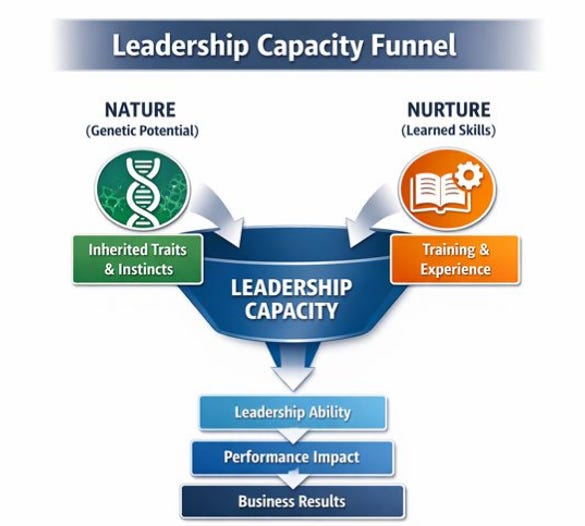
Leadership Capacity Funnel (tm)
Why didn’t we jump on this genetic research earlier?

Someone smarter than me probably knows the answer, but I’m betting on “fear”:
-
Fear of bad science. Eugenics was a grotesque misuse of genetics. The National Human Genome Institute declares that eugenics was the scientifically erroneous and immoral theory of ‘racial improvement’ and ‘planned breeding’ by using methods such as involuntary sterilization, segregation, and social exclusion. We should be afraid of this.
-
Fear of good science. It’s difficult enough to learn leadership theory without having to also study evidence-based genetic research, evolutionary psychology, and brain science. It’s just easier to quote a best-seller where authors never read scientific literature but sound smart.
These fears drove avoidance:
-
Academia avoided it due to political backlash.
-
HR avoided it because it breaks the everyone-has-potential myth.
-
Consultants ignored it because it can’t be productized or defended without a lot of time to understand it.
What To Do
Let’s bury the myth that leadership can be taught to anyone.
Leadership starts with nature, then gets sharpened by nurture.
Here’s what smart companies do:
-
Find the Inheritors: Start with wired leaders — don’t waste time trying to fabricate them. Identify those with innate leadership capabilities. You’ll feel it before you see it.
-
Sharpen, Don’t Fabricate: Train what’s already there. Don’t try to sculpt leaders from people who were never wired to lead.
-
Self-Reflect: If you’re already in a leadership role, ask: which traits came naturally? Focus on honing those.
-
Development ROI: Rethink your L&D budget. Invest in refining instincts, not manufacturing them.
-
Self-Assessment for Leaders: Ask what came naturally — not what was taught.
Call to Action
1) Forward this to friends and colleagues.
Let them join you in the revolution against the status quo.
2) Comment on your experience of this topic.
It helps our community a lot.
3) Go further (your competitors are reading this too).
The difference? They’ll keep running initiatives that change nothing. Keep complaining teams “lack urgency.” Keep creating plans that die in execution.
Or they’ll do what 75 executive teams do annually: Bring me in to show why their management theories fail—and what actually works.
Here’s what I don’t do: Workshops on “alignment”, motivational speeches, or ideas that sounds brilliant in the boardroom but die in implementation.
Here’s what happens instead: Your team learns the research from MIT, Johns Hopkins, and decades of fieldwork explaining why initiatives failed. Then we fix it.
“It’s the first event we’ve ever had where people actually implemented something.”
Whether a keynote, retreat, or offsite—the goal is the same:
-
Move the needle.
-
Make it unforgettable.
-
Create an experience where they actually do something differently afterward.
Press kit & inquiries: [email protected]
P.S.: My calendar is 60% booked through year end. Let’s talk. Your funding supports our research.

Responses