

For this post I am conflicted as a write this.
I don’t want add a meme to the pile of crap we have to wade through every morning at the office, but I just can’t help myself this time.
Every conference presentation and consultant brochure has the word ALIGNMENT.
Cue the clip art. Cue the yawns. Then go home, add three more meetings, and wonder why execution still moves like molasses in a walk‑in freezer.
But after years of “experts” showing us how to do it, why are we still talking about it?
To prevent another decade of ALIGNMENT, what if we sought a better alternative rarely used in management — science.
So have some fun with me on a new experiment — Quantum Coherent Leadership (QCL).
What’s your QCL quotient?
Wait. What?
Let’s back up. Traditional science says your consciousness “emerges” from zillions of neurons doing synchronized gymnastics in the warm, wet, tissue in the space between your ears. Your brain’s neural circuits, especially large-scale, interacting networks (cortex–thalamus loops, fronto-parietal systems, etc.) are viewed as an emergent property of coordinated neural dynamics.
A lot of words, but Ok. Let’s go with that.
But it might be dead wrong.

New quantum discoveries suggest consciousness could be quantum. A small, noisy camp of scientists say quantum effects inside neurons might matter.
But this is all wacky, correct?
Maybe.
Except for when someone like Sir Roger Penrose says something.
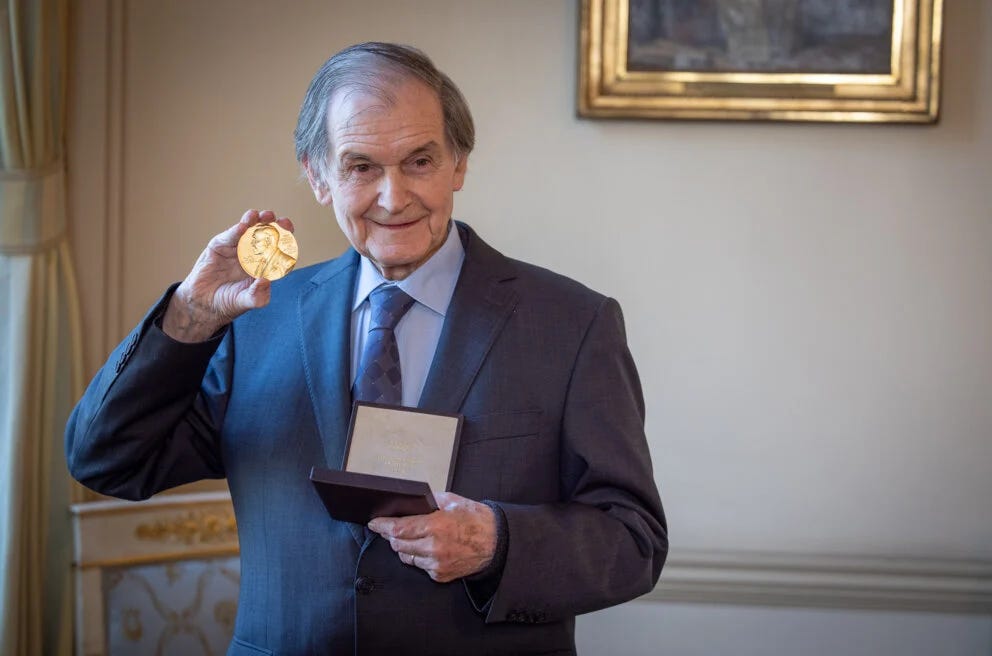
Yes. He’s holding his Nobel Prize.
I like to learn from someone who won a Nobel prize in Physics, The Dirac Medal, the Albert Einstein Medal, and too many other prestigious science to mention here.
How does Sir Penrose explain quantum consiouness?
The Penrose–Hameroff’s Orch-OR model suggests the culprit could be:
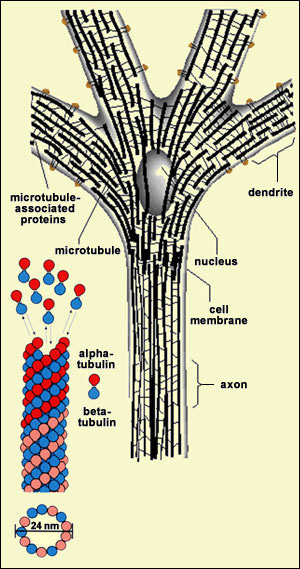
Microtubules!
Yes, tiny structures in your neurons process quantum computations that literally create awareness. Not through standard logical or classical computational processes, but through a quantum event called a wavefunction collapse.
What’s that?
Well let’s take a geek moment to explain this. Buckle up.
Think of a Wavefunction Collapse as how Reality makes up its mind.
Let’s say you’re about to open a fortune cookie.
Before you crack it open, you can imagine ten different messages—wealth, loneliness, love, adventure, etc. In quantum physics, every particle in the universe is like that unopened fortune cookie. It doesn’t have just one outcome. It holds all of them—simultaneously, all at once.
That haze of possibilities is called a wavefunction—a mathematical map of every place the particle might be and every path it might take. Before the collapse, the particle isn’t in a single location; it’s in a superposition, a combination of possibilities.
Then comes a measurement or observation:
BOOM: the wavefunction collapses.
It picks a reality.
The wavefunction collapses, and the particle settles into one outcome. The other possibilities vanish from reality. The universe slams the door shut on all the rest of them.
Sort of like your startup project both succeeding and failing simultaneously — until your first customer or investor finally calls your bluff.
Here’s the catch: scientists don’t yet know exactly what triggers collapse, or whether the act of measurement changes the outcome or simply reveals it. All we know is that once nature “checks the fortune in the cookie,” no other futures remain .
Sir Penrose proposes that’s what’s happening in your brain. These microtubules within neurons are central to generating conscious awareness.
Now that’s a thought!
It gets wilder!
Those quantum events might entangle your mind with the universe.
What?
Yes. “Entanglement” is a physics term describing a phenomenon where two or more particles become linked together in such a way that they share the same quantum state, regardless of the distance separating them!
That means altering a property of one entangled particle instantly influences the other particle, even if they are light-years apart!
This "spooky action at a distance," as Einstein called it, is a fundamental aspect of quantum mechanics with profound implications for quantum computing and cryptography.
Penrose and Hameroff’s Orch-OR theory suggests that quantum events in microtubules—specifically, orchestrated wavefunction collapses—are not just isolated to the brain
. . . but are deeply connected with the fundamental structure of the universe itself!
You mean our consciousness might be “connected” with the universe?
Yes.
Your thoughts may not be isolated — but synced across time and space - because of these tubules in your brain.
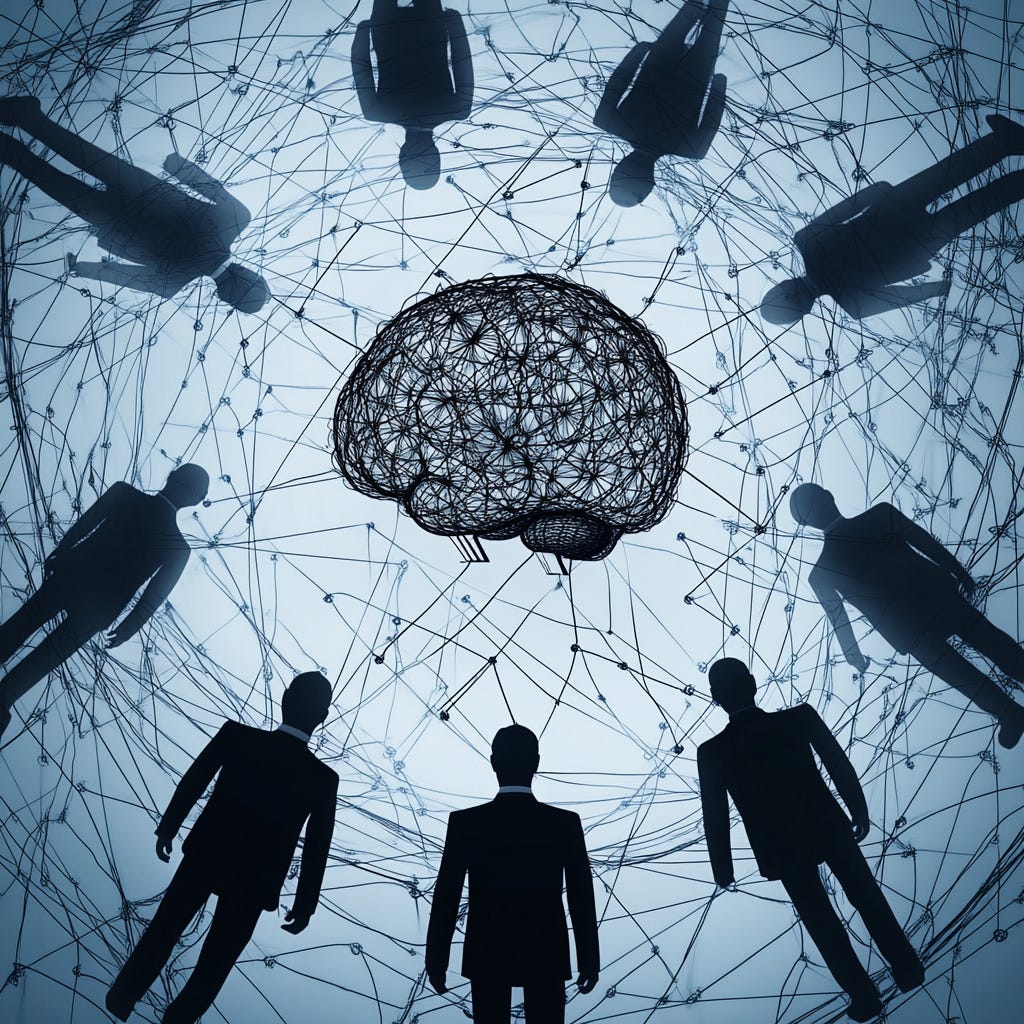
Think about that for a moment.
Oh, so did everyone else; just now.
Consciousness may be occurring from quantum processes inside your brain, extending beyond biology, and connecting your mind to the universe itself.
How does this apply to the office?
I don’t know, but I just had a thought (pun):
What if leaders could connect their brain to the organization itself?

Ponder this. What if we kill the illusion about how we align and engage employees?
What if we used entanglement as a metaphor for a new form of leadership?
Email, memos, chats, collaboration tools, town halls—none of that is connection. It’s traffic. Without coherence, traffic is gridlock with emojis.
And your teams? They behave like unlinked neurons. Which explains why:
-
Strategy takes months.
-
Cultures fracture.
-
Innovation flatlines.
-
“15‑minute” meetings eat an hour.
-
Projects crawl.
-
Execution becomes corporate tag.
What if we could instead imagine teams sensing shifts and adapting instantly — not because they were told, but because they’re entangled in purpose and instinct. Even before memos are written, imagine a culture that reinforces instinctive collaboration, not because it’s “on brand,” but because it’s embedded.
This isn’t agile.
It’s quantum speed through coherence, not control.

Management experts love using science and engineering terms metaphorically for new theories. Where do you think “networking” came from. Or organizational DNA. Or “viral”.
I’ve always avoided this, but just can’t help myself anymore. Let’s start a new metaphor that explains quantum connection . . .
⚡ Enter the QCL Organization
Quantum Coherent Leadership (QCL)™ :
Definition: Autonomous individuals or teams making bold, aligned moves at high speed based on deep coherence, not endless analysis, politics, processes, meetings or approvals. Strategic entanglement → decisive action.
Let's explore.
I’m not sure where this is going but let's take a shot. Join me at the white-board here as we unleash this crazy idea.
Remember what Danish physicist Niels Bohr, the father of quantum physics, said to a young physicist:
We are all agreed that your theory is crazy. The question is whether it’s crazy enough to be correct.
If you let old beliefs die, and consider this new reality, what possibilities exist? What would happen if you tested this?
I’ll start you up, then you take it from here:
-
Collapse the Classical Hierarchy?
Just as quantum particles don’t obey classical rules, your company shouldn’t be bound by outdated chains of command. Shift from a command model to a coherence model — where insight, intuition, and initiative are distributed and synchronized. Replace approval bottlenecks with trust-based execution protocols. What levels of conversation should occur so everyone knows what decisions should occur in different situations? How can you test and adapt this? -
🌐 Embed Coherence in Culture?
Microtubules don’t need memos to sync. Neither should your teams. Create cultural microtubules — shared mental models, strategic clarity, and values that autocorrect drift and self-reinforce adaptive behavior. Think less policy, more purposeful story. Culture should autocorrect misalignment. Kill approval bottlenecks. Ship with trust‑based protocols and post‑hoc audits. Authority = clarity × competence. -
🧠 Train for Quantum Thinking?
Most leadership development focuses on logic, planning, and control. That’s classical. Quantum organizations train leaders to thrive in uncertainty, ambiguity, and paradox. Encourage intuition, reflection, and decision-making under conditions of incomplete data. Induce paradox fluency. Decisions with incomplete data. Retire certainty worship; promote adaptivity. -
🔌 Wire for Instant Feedback
Quarterly reviews belong in a museum. Instrument the work; pipe real‑time customer and ops telemetry to the front line. Microtubules operate at light speed. So should your feedback loops. Ditch quarterly reviews. Build always-on sensing systems that give teams real-time insight into performance, customer sentiment, and market shifts. -
🤝 Reward Synchronicity, Not Heroics
Retire lone‑wolf myth. Celebrate choreographed wins. The future is symphonic, not solo. In classical orgs, we reward star players. In quantum orgs, we reward coherent execution — teams that move together seamlessly.
That’s it for now!
Any ideas on how to build a quantum-coherent organization in your situation?
Jump in on the comments and, if enough interest, I’ll followup with more research in a future blog.
Call to Action
1) Forward this to friends and colleagues.
Let them join you in the revolution against the status quo.
2) Comment on your experience of this topic.
It helps our community a lot.
3) Go further (your competitors are reading this too).
The difference? They’ll keep running initiatives that change nothing. Keep complaining teams “lack urgency.” Keep creating plans that die in execution.
Or they’ll do what 75 executive teams do annually: Bring me in to show why their management theories fail—and what actually works.
Here’s what I don’t do: Workshops on “alignment”, motivational speeches, or ideas that sounds brilliant in the boardroom but die in implementation.
Here’s what happens instead: Your team learns the research from MIT, Johns Hopkins, and decades of fieldwork explaining why initiatives failed. Then we fix it.
“It’s the first event we’ve ever had where people actually implemented something.”
Whether a keynote, retreat, or offsite—the goal is the same:
-
Move the needle.
-
Make it unforgettable.
-
Create an experience where they actually do something differently afterward.
Press kit & inquiries: [email protected]
P.S.: My calendar is 60% booked through year end. Let’s talk. Your funding supports our research.
Thanks for joining us in a quiet rebellion against status-quo leadership.
Stay dangerous.
REFERENCE SOURCES:
FOOTNOTE FOR THE SCIENCE‑FAITHFUL
(because someone will ask)
Selected reading:
-
Hameroff & Penrose (2014, Physics of Life Reviews)
-
Consciousness in the universe: a review of the 'Orch OR' theory (Phys Life Rev. 2014 Mar;11(1):39-78).
-
Hagan et al. (2002, Phys. Rev. E)
-
Hagan, Hameroff & Tuszyński, Quantum computation in brain microtubules: decoherence and biological feasibility, Phys. Rev. E 65, 061901 (2002).
-
Tegmark (2000, Phys. Rev. E)
-
The importance of quantum decoherence in brain processes, Physical Review E, 61:4194–4206, 2000.
-
Khan/Huang/Timuçin/Wiest et al. (2024, eNeuro)
-
eNeuro 11(8):ENEURO.0291-24.2024, Aug 2024), and the Society for Neuroscience.
-
NobelPrize.org (Penrose facts)
-
Roger Penrose’s official Nobel Prize facts page exists and is accurate for the 2020 Physics Nobel.
-
Caltech Science Exchange (Entanglement explainer)
-
The Caltech Science Exchange provides an authentic explainer on quantum entanglement.
-
Penrose, R., & Hameroff, S. (1996) in Journal of Consciousness Studies
-
Orchestrated Reduction of Quantum Coherence in Brain Microtubules: A Model for Consciousness. Journal of Consciousness Studies, 3(1), 36–53. This is where they published the Orch OR model.
-
J. A. Tuszyński et al. (2020, Phys. Rev. E)
-
Tuszyński, J. A., et al. (2020). Quantum Processes in Microtubules and the Nature of Consciousness. Physical Review E, 102(4), 045003.
-
Wiest, M., et al. (2024, eNeuro)
-
Wiest, M., et al. (2024). Anesthetic Effects on Microtubule Stability and Consciousness in Rats. eNeuro, 11(8), 22-35. Hameroff, S., & Penrose, R. (2014)..
-
Vitiello, G. (2001) Physical Review E
-
Manasee Wagh Published: Dec 19, 2024 9:00 AM EST
-
Your Consciousness Can Connect With the Whole Universe: This latest clue about the architecture of consciousness supports a Nobel Prize winner's theory about how quantum physics works in your brain.
-
Shubham K. Dominic
-
Consciousness Beyond the Brain: The Quantum Connection to the Cosmos Quantum Mechanics | 24 | xii | Physicspapers.Ijks.com

Responses