

Your pursuit of alignment is costing you more than you know. Every ‘alignment session’ you schedule might be delaying decisions, diluting strategy, and destroying accountability—all while making you feel responsible and thoughtful.
Here’s what research actually shows about what happens when organizations prioritize consensus over action...
“ALIGNMENT”: A simple concept: Important decisions require alignment across stakeholders.
Walk into any company and you hear it constantly:
-
“We need to get the team aligned before we move forward”
-
“Let’s schedule an alignment session”
-
“I don’t think we have full alignment yet”
Every change management framework and leadership book promises “engagement” and “buy-in” when you have alignment. It appears in every MBA program.
The theory’s seductive: Better decisions and hard choices get made with consensus and inclusivity. It reduces implementation risk.
On the surface, it sounds responsible. Mature. Thoughtful.
So what’s the problem?
Busted: How Alignment Kills Performance

“Alignment” might be the most expensive lie leaders tell themselves.
Why?
The problem isn’t the intent—it’s how the concept mutates.
It becomes another form of Tool Seduction™
You stop using the tool and the tool starts using you.
WARNING:
Has alignment devolved into a sophisticated delay mechanism in your organization?
Has the need for it hijacked your strategic agility?
I’m not saying this is happening because your leaders are indecisive, although some might me, but because alignment feels like progress even when it isn’t.
BTW, this isn’t a rant against alignment.
We need alignment.
This is about researching a mutation on HOW alignment is done — is consensus still useful and, if not, what should we use instead ?
. . . btw - a shout out to someone in our community. Thanks to Joe Daggar, VP of Tech & Enablement, at a great company, PuzzleHR.com, for alerting me that I needed to add this to clarify it more up front (you’ll see the irony in my error on “clarity” later in the text 😲 😂)
You’d think consensus helps. It makes sense. I taught concensus-building in my early executive leadership programs. It’s one of the earliest concepts that started taking off decades ago in the 70’s
And it does work. Until it doesn’t.
You can imagine my surprise when I saw the published research:
Alignment-seeking systematically produces three costly failures
1. Decision delay masquerading as diligence
In a study of 356 organizational decisions, roughly half failed.
Well, I guess we have a chance to get it half right.
Why? Many tried to build participation the wrong way.[2] The delays had real costs—missed market windows, extended uncertainty, and competitive disadvantage. Does layering in more people slow decisions without improving their odds of success?
Do your decision delays masquerade as diligence?
2. Regression to the safe middle
Research shows that when groups seek consensus, they can end up with more cautious or conformity‑driven outcomes.[3] Research on group decision‑making summarized by Sunstein and Hastie shows that consensus‑seeking groups tend to drift toward safer, lower‑return options, even when the evidence favors bolder moves.[3]
Is the need to accommodate dissent diluting strategic clarity in your company?
3. Accountability diffusion
I forgot where I heard this: “When more than one person is involved, no one will be at fault.”
The point comes home here — when everyone must align, no one truly owns the outcome. A Harvard Business Review analysis HBR research by Sull, Homkes, and Sull shows that vague, overly collaborative decision environments correlate with execution breakdowns—particularly when ownership is diffused and follow‑through is inconsistent. [4]
Are decisions worse using collaborative decision-making?
No. Of course not.
The problem is:
Implementation collapses because ownership has been distributed into non-existence!
I guess we just need to assess what’s going on right now, and monitor it closely.
Seek alignment . . . until the harder you work to achieve it, the more you struggle with execution.
The Hidden Math of Alignment Culture
Consider a typical Fortune 500 strategic decision delayed 6 months while seeking consensus:
-
Market window missed: $5M in first-mover advantage because competitor gets a 6-13 percentage point market share advantage (McKinsey data on launch timing)
-
Extended uncertainty: 12% productivity drag on 200-person implementation team (HBR study)
-
Competitive loss: Rival captures 15% market share during your delay (Nutt’s decision failure research)
Conservative estimate: $2M–$8M per major delayed decision.
Most organizations make 3–5 such decisions annually!
Now how does this impact your organization? Even if a smaller company, nobody likes to lose several points in new profit annually.
DeMystify: What The Experts Miss
So why does something that sounds so effective fail so much?
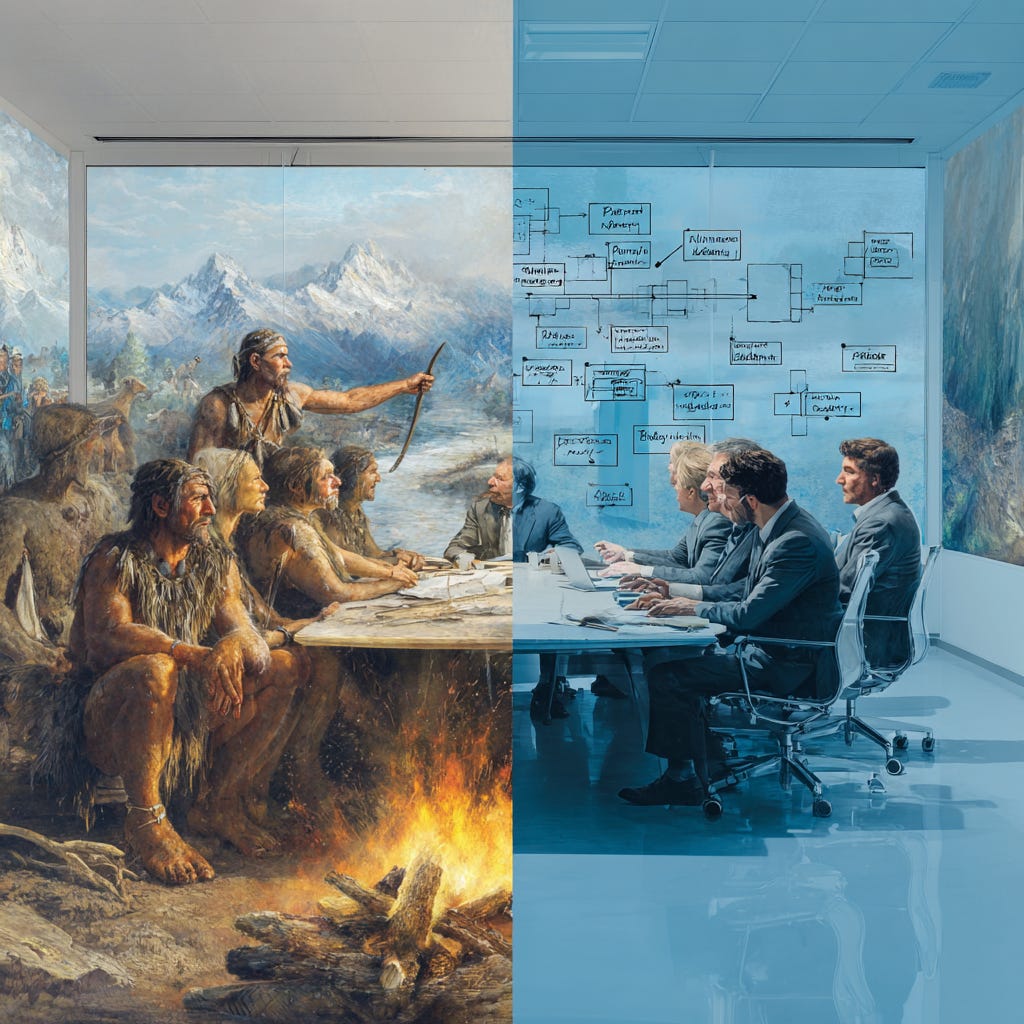
This bothered me. So I ventured back into evolutionary psychology to see how our species actually formed this concept. I finally found an answer.
We’ve misdefined what alignment really is!
Let’s look at a fundamental biological reality about how humans make decisions.
The Evolutionary Reality - We align around competence
For most of human history, small groups made decisions through a very different process than modern “alignment.”

Anthropological research on hunter-gatherer societies reveals something fascinating. They didn’t have time for alignment training, or extended meetings to make sure everyone felt good about a decison.
They needed speed! They only had time for food, mating, safety, and maybe some drinking games.
So, what sped things up?
Decision authority followed demonstrated competence in the issue at hand, NOT group consensus[5]
This became clear in anthropological ethnographic work, such as Boehm’s research on hunter‑gatherer societies, which showed that consequential decisions defaulted to those with who knew what they were doing, not to the group as a whole.
-
If the question was where to hunt, the experienced hunters decided.
-
If it was when to move camp, those who read weather patterns decided.
Others might be consulted, but they weren’t waiting for everyone to “align”!!!
Why?
Survival depends on decision quality . . . not decision comfort.
The group’s role wasn’t to agree—it was to understand clearly enough to act.
That’s a profound difference from how we practice alignment!
It’s about quality, not comfort.
How much faster would your meeting go if this was the rule?
Now let’s look at where alignment failed from this lack of clarity:
The Survivorship Bias Parallel
1. Swissair: Consensus That Blew Up the Airline
Swissair was once known as the “Flying Bank” — a bastion of financial strength and strategic stability.
But when its leadership culture prized harmony and consensus over challenge and critique, it developed classic symptoms of groupthink. Even as market conditions shifted, dissent was stifled and critical questions about strategic choices were muffled. Ultimately, poor decisions went unchallenged — and the airline collapsed.
Lesson: When alignment becomes an euphemism for everyone agreeing with the loudest voices, risk blindness follows.
2. Delayed Launches Across Industries
In product organizations worldwide, internal factors—late‑stage design changes, lengthy approval cycles, and ‘alignment’ debates—are a frequent cause of launch delays, often more so than external blockers like supply chain disruptions.
These delays are not neutral. They cost market share, dampen team momentum, and signal indecision to the rest of the business.
Lesson: When alignment trumps action, timing becomes collateral damage.
3. Nokia’s “Burning Platform” and the Alignment Trap
In 2011, Nokia’s CEO Stephen Elop famously sent the internal “Burning Platform” memo acknowledging market shifts that the company had long failed to internalize. Nokia had been so focused on internal alignment around legacy strategy (Symbian, hardware roadmap, Nokia culture) that it missed how rapidly ecosystems (Apple, Android) were redefining the market.
That internal alignment on the old strategy made it slower to pivot when the external world changed.
Lesson: Alignment on yesterday’s priorities can be worse than no alignment at all.
Now look at your company.
-
Is the need for consensus diverting you from optimizing for action?
-
Is the appearance of agreement disrupting the quality of action?
When you seek alignment first, you’re measuring the wrong thing. You’re counting how comfortable everyone is rather than whether the decision is sound.
The Neuroscience Problem
We’re not done yet. Here’s what makes this worse: The human brain treats social agreement as evidence of truth.
Neuroscience research shows that when our position differs from the group, our amygdala (the brain’s threat-detection system) activates.[6] Disagreement literally feels dangerous. Alignment feels safe.
This makes sense. If a tribe ostracizes you, it could be fatal. You’re safer with a group then alone out there, and you look like food!
This means that in alignment-seeking cultures, leaders aren’t just being cautious—maybe they’re physiologically rewarded for postponing decisions until consensus emerges.
OK, so what’s the problem?
Markets don’t wait for your amygdala to feel comfortable.
My colleague Joel Block, a former hedge fund manager turned Strategy Futurist, put it perfectly in his recent piece. His view on “consequence over consensus” directly supports this research. Read it after you finish. It’s a great piece:
What To Do: Reframe It
Here’s the crucial distinction most leaders miss:
True strategic alignment isn’t about unanimous agreement — it’s about functional clarity.
💡 SHARE THIS WITH YOUR MANAGER OR TEAM
From the article: “Do we need agreement, or do we need clarity? Most of the time you’re counting how comfortable everyone is rather than whether the decision is sound.”
→ Forward this to your leadership team
Let’s pull all this together now:
You want:
· People to understand the direction.
· People to trust those who have demonstrated competence on the issue.
· People to commit to action when it’s time to execute.
You don’t need:
· Everyone to like the choice.
· Everyone to agree before you act.
In fact, demanding consensus before execution is often just “alignment theater” — a ritual that delays impact and amplifies groupthink.
The job of senior leadership is not to align people around a decision.
It’s to make decisions clear enough that coordinated action becomes possible.
How do you do this?
I think it requires three fundamental shifts:
1. Clarity ≠ Agreement
Alignment is not a prerequisite for good decisions. It’s a byproduct of clarity.
When you make the situation explicit—what we’re doing, why, what we’re trading off—people don’t need to agree to move forward. They need to understand.
Ancient military strategist Sun Tzu observed this 2,500 years ago that when orders are clear and consistently enforced, there is harmony between the commander and troops.[7]
Not mutual agreement, but mutual understanding.
2. Dissent Can Exist Within Execution
Some of the most effective organizations I’ve studied have a simple operating principle: “Disagree and commit.”
Once a decision is made, you execute fully—even if you argued against it. This isn’t about suppressing dissent. It’s about separating the decision phase from the execution phase.
Amazon institutionalized this principle explicitly. Jeff Bezos wrote: “Have Backbone; Disagree and Commit.” Leaders are obligated to respectfully challenge decisions when they disagree... [but] once a decision is determined, they commit wholly.”[8]
This is the opposite of alignment culture, which confuses “getting comfortable” with “getting ready.”
3. Speed Is a Feature, Not a Bug
George Stalk introduced me to an insightful military concept called the OODA loop: Observe, Orient, Decide, Act. The theory is simple: Those that cycle through this loop faster, win.[9]
Every hour you spend building alignment is an hour your competitor isn’t spending. They’re acting. Learning. Iterating.
Your pursuit of consensus isn’t making you careful. It’s making you slow.
Actions For Today
Pay attention to your language:
-
When you say, “We need alignment,” ask: Do we need agreement, or do we need clarity?
-
When someone requests an “alignment session,” ask: What decision are we avoiding?
-
When you hear, “Does everyone agree?”, ask: Does everyone understand the decision, and will everyone execute even if they disagree?
-
When a decision stalls waiting for consensus, ask: What would actually break if we decided today? . . . Most of the time, the answer is — less than you think.
Or, use what I learned in some cultures, like in Japan and ancient Persia — if we don’t all agree, it means we aren’t fully clear on the real problem. There’s the pesky clarity thing again.
Let’s Align Around This
The real cost isn’t the decision you make—it’s the decision you delay while waiting for everyone to feel comfortable.
Where in your organization has the pursuit of alignment quietly replaced leadership?
Not as a moral failure—but as an expensive habit you can no longer afford.
Because here’s the truth:
· Alignment is easy.
· Leadership is hard.
Which is your team choosing?
That’s enough for now, see you again in a couple weeks.
— Don
Call to Action
1) Share this with friends and colleagues.
Spread the word. Let them join you in the revolution.
2) Comment on your experience.
Has this topic occurred in your life? Let the community know. It’s helps us all learn.
References
[2] Nutt, P. C. (1999). “Surprising but True: Half the Decisions in Organizations Fail.” Academy of Management Executive, 13(4), 75-90.
[3] Sunstein, C. R., & Hastie, R. (2015). Wiser: Getting Beyond Groupthink to Make Groups Smarter. Harvard Business Review Press.
[4] Sull, D., Homkes, R., & Sull, C. (2015). “Why Strategy Execution Unravels—and What to Do About It.” Harvard Business Review, 93(3), 57-66.
[5] Boehm, C. (1999). Hierarchy in the Forest: The Evolution of Egalitarian Behavior. Harvard University Press.
[6] Berns, G. S., et al. (2005). “Neurobiological Correlates of Social Conformity and Independence During Mental Rotation.” Biological Psychiatry, 58(3), 245-253.
[7] Sun Tzu (5th century BCE). The Art of War. Translated by Samuel B. Griffith (1963).
[8] Amazon. (2023). “Leadership Principles.” Corporate website.
[9] Boyd, J. (1996). “The Essence of Winning and Losing.” Unpublished briefing, published posthumously.

Responses